Turquoise Facts

Turquoise Facts

All you need to know about turquoise

Fact 1: Turquoise is one of the oldest gemstones in human history, dates back to 6000BC, it is called a gemstone of the life, and is esteemed for thousands of years as a holy stone, a bringer of good and fortune. 

Fact 2: From ancient Egypt, Persian Empire, Shang Dynasty of China, to most of Native Americans, turquoise is regarded as a good-luck-charm or a talisman. It can be found on the most important antiques in all of these human civilizations. It is on King Tutankhamun's golden mask.  It is believed to have healing property, truly captivating power and considered as protection against evil and ill health. 

Fact 3: Persian philosopher Al Kazwini wrote: "The hand wearing a Turquoise and using it as a sealing stone, will never be poor.” 

Fact 4: Turquoise was always worn as protection to ward off the influence of dark and evil powers. Formerly it was thought to protect riders and horses from accidental falls, and are nowadays considered the ideal good-luck stones and with great Healing Powers.

Fact 5: Birthstone for December. The old says:

"If cold December gave you birth.
The month of snow and ice and mirth.
Place on your hand a turquoise blue;
Success will bless whate'er you do."
 
Fact 6: Turquoise is gemstone for 11th anniversary of marriage. 
 
Steeped with history and mystery turquoise is truly a captivating stone. In many cultures of the Old and New Worlds, this gemstone has been esteemed for thousands of years as a holy stone, a bringer of good fortune or a talisman. It really does have the right to be called a 'gemstone of the peoples'. The oldest evidence for this claim was found in Ancient Egypt, where grave furnishings with turquoise inlay were discovered, dating from approximately 3000 BC. 
In the ancient Persian Empire, the sky-blue gemstones were earlier worn round the neck or wrist as protection against unnatural death. If they changed color, the wearer was thought to have reason to fear the approach of doom. Meanwhile, it has been discovered that the turquoise certainly can change color, but that this is not necessarily a sign of impending danger. The change can be caused by the light, or by a chemical reaction brought about by cosmetics, dust or the acidity of the skin. A common belief shared by many of these civilizations held that turquoise possessed certain prophylactic qualities; it was thought to change color with the wearer's health and protect him or her from untoward forces.

The pastel shades of turquoise have endeared it to many great cultures of antiquity: it has adorned the rulers of Ancient Egypt, the Aztecs, Persia, Mesopotamia, the Indus Valley, and to some extent in ancient China since at least the Shang Dynasty. Despite being one of the oldest gems, probably first introduced to Europe with other Silk Road novelties through Turkey, turquoise did not become important as an ornamental stone in the West until the 14th century, following a decline in the Roman Catholic Church's influence which allowed the use of turquoise in secular jewelry. In Persia, turquoise was the national stone for millennia, extensively used to decorate objects, mosques, and other important buildings both inside and out. The Egyptian use of turquoise stretches back as far as the First Dynasty and possibly earlier; however, probably the most well-known pieces incorporating the gem are those recovered from Tutankhamun’s tomb, most notably the Pharaoh's iconic burial mask which was liberally inlaid with the stone. The French conducted archaeological excavations of Egypt from the mid-19th century through the early 20th. These excavations, including that of Tutankhamun's tomb, created great public interest in the western world, subsequently influencing jewelry, architecture, and art of the time.

After the 4th or 5th century A.D., many writings that appeared discussed the stone.  Explorers such as Marco Polo took time to write about it. Certainly, the prehistoric peoples of the Western hemisphere knew about turquoise; pieces have been found in burial and archeological sites throughout the two continents. 

It also has a long standing history of over one 1000 years with Native Americans who have used it extensively for protection and healing. The stone was also used in religion, art, trade, treaty negotiations, and jewelry. Turquoise's use as a healing stone reaches far – it has been used for headaches, eye problems, fever and insect bites to name just a few. It was ground to a powder then drank to cure stomach ailments. Turquoise also has significant metaphysical properties. It is a harmonizing stone that is said to alleviate nervousness, help with problem solving, relieve stress from a hectic life, and promote friendship. It is also well known for its protective qualities and many cultures carry a turquoise stone with them at all times.

Another process is referred to as “Block” where a mixture of plastic resin and dyes are produced in blocks the size of a loaf. There is no actual turquoise in this mix, it is entirely man mad and should be labeled simulated. It is made in many colors, and it is used extensively for inlay work.

Geology Info:

Chemical Formula: CuAl(PO4)(OH)8:4H2O

Color: Blue, Bluish-green, green.

Hardness: 6

Density: 2.6 to 2.8

Crystallography: Triclinic

Optics: (Refractive Index)  a = 1.61; b = 1.62; y = 1.65


Turquoise Formation

Turquoise forms when water percolates through rocks that contain copper, aluminum and other minerals. A chemical reaction takes place that results in deposits of what we know as turquoise. That's a simplified way of describing a process that takes millions of years and only happens when a complex set of conditions come together.

Why is Turquoise Different Colors?

The blue in turquoise is enhanced when copper is present. If the area where turquoise is formed contains more aluminum, the turquoise will shade to green. When zinc is present, the deposits are a yellow-green color, a rare combination that so far has been found in only a few areas, including the Carico Lake and Blue Ridge mines in Nevada. (See turquoise being mined.)

Why Are There Dark Markings in Turquoise?

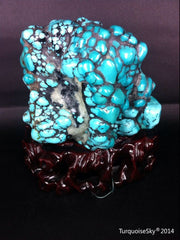
That's the matrix, the rock that the turquoise formed in. When stones are cut, some of the matrix remains bound to the turquoise. Matrix color varies because turquoise can form in different types of rock.

  • Black matrix may be iron pyrite
  • Yellow matrix could be rhyolite
  • Brown is probably iron oxide
  • The term spider webbing refers to stones with thin lines of matrix distributed throughout them

Is Turquoise a Hard Stone?

Hardness of turquoise used for jewelry usually varies from 5-6 on the Mohs scale. The hardest turquoise is usually found nearest the surface of the earth, where it's had a chance to dry, or cure. Softer turquoise is chalk-like -- too soft and porous to be used unless it's treated.

What is Natural Turquoise?

Natural turquoise may have been cut and polished, but no artificial changes have been made to the gems. Color may change over time as body oils and other sources of moisture are absorbed into the stones.

Only high quality turquoise can be used in its natural state.

How To Care for Your Turquoise

Handle your turquoise jewelry carefully to avoid scratching it. Don't store turquoise with harder gemstones or other materials that might rub against it and cause damage.

Keep turquoise away from high heat and chemicals such as oils, perfumes, and household cleaners. Even stabilized turquoise can be affected by a constant bombardment of chemicals.

Clean your turquoise in warm, sudsy water and dry it immediately with a soft cloth. Avoid commercial jewelry cleansers.


For additional information about turquoise, please click Here.

References:

1. Geology information about turquoise: Click Here

2. Mineral Specimen Info: History of turquoise.

3. Wikipedia Turquoise page

4. About.com Turquoise General Info Page

5. Turquoise Facts

See Terms & Conditions for our disclaimers.